


field and folk art from Golden, Colorado
Kinnikinnick, Arctostaphylos uva-ursi
Ute: tahmahup; Arapaho: Noh’úwunobí:se’ (“smoke plant berries”), Noh’uwúno’ (“bearberries”); Cheyenne: No?aneonotse, ma?kemenotse (“red berry”)
flowering season: March - June
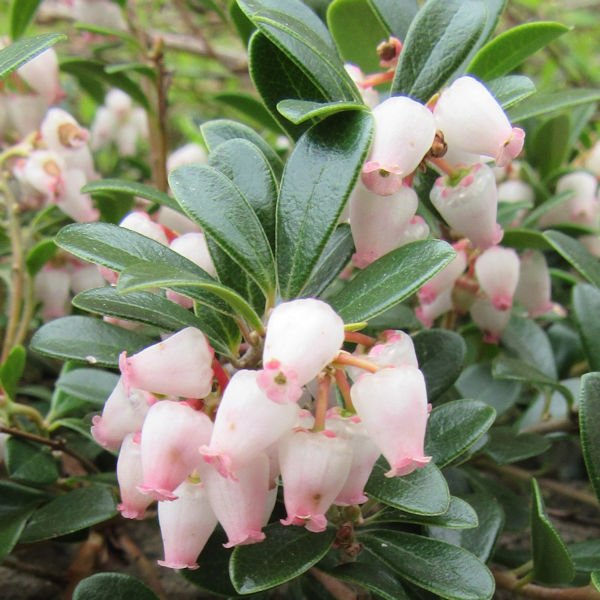
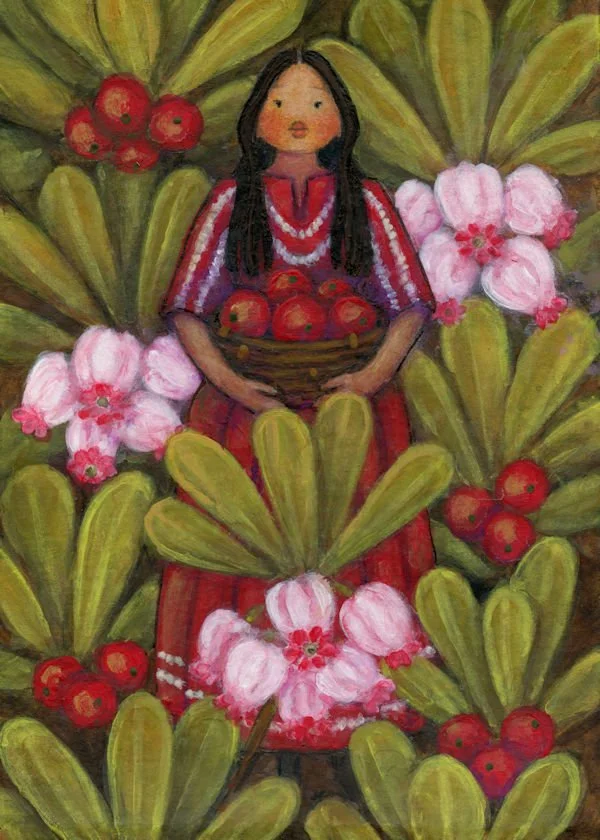
A low-growing evergreen shrub, she grows into large mats that carpet forest floors. Her leaves are shiny and leathery, her tiny bell-shaped flowers hang in small clusters in spring, and bright red berries form in late summer. Young leaves can be made into a tea, a traditional medicine for urinary tract health. Bears in particular utilize this plant - in late fall, they eat the berries and other vegetation to create a blockage in their digestive system for the winter hibernation season. She can also be used to make a yellow dye.
She is often called Kinnikinnick, an Algonquin word widely used to describe traditional smoking blends, often including the leaves of this plant. Beyond that, bearberry has been used in many ways~ as a nutritional source (the berries, high in Vitamin C, were cooked with meat and dried into cakes by Indigenous peoples), and as medicine (now commonly found in most supplement aisles), as a grounding presence on the land, and as part of cultural practices that are specific to the nations who hold that knowledge.
Shop prints of Kinnikinnick~ 5×7 * 8×10 * poster print
Kinnikinnick, Arctostaphylos uva-ursi
Ute: tahmahup; Arapaho: Noh’úwunobí:se’ (“smoke plant berries”), Noh’uwúno’ (“bearberries”); Cheyenne: No?aneonotse, ma?kemenotse (“red berry”)
flowering season: March - June
A low-growing evergreen shrub, she grows into large mats that carpet forest floors. Her leaves are shiny and leathery, her tiny bell-shaped flowers hang in small clusters in spring, and bright red berries form in late summer. Young leaves can be made into a tea, a traditional medicine for urinary tract health. Bears in particular utilize this plant - in late fall, they eat the berries and other vegetation to create a blockage in their digestive system for the winter hibernation season. She can also be used to make a yellow dye.
She is often called Kinnikinnick, an Algonquin word widely used to describe traditional smoking blends, often including the leaves of this plant. Beyond that, bearberry has been used in many ways~ as a nutritional source (the berries, high in Vitamin C, were cooked with meat and dried into cakes by Indigenous peoples), and as medicine (now commonly found in most supplement aisles), as a grounding presence on the land, and as part of cultural practices that are specific to the nations who hold that knowledge.
Shop prints of Kinnikinnick~ 5×7 * 8×10 * poster print
Quisque iaculis facilisis lacinia. Mauris euismod pellentesque tellus sit amet mollis.